
Tired of the same old boring “safe” e-cards floating around the web? Someecards has a variety of non-PC cards that are plenty offensive (some even to me).
Reflections along the way.
Tired of the same old boring “safe” e-cards floating around the web? Someecards has a variety of non-PC cards that are plenty offensive (some even to me).
Here’s a meditation I wrote 3 years ago about the magic of Christmas. Like Chesterton, I learned to believe in God in the fairy tales of childhood. Here is on attempt to capture that believe in wonder.
Every year cartoons and movies retell the same story: the story of a child or an adult who has lost the wonder of Christmas, “the Christmas spirit.” Every year the tale of innocence and experience is retold through the lens of Santa Claus and a heart that needs only believe.
Christmas is the time when we hope, we wish, we dream it might all really be true. Of course, we know better. And yet deep within us there is a longing for that place called the North Pole. The sophisticated refuse to waste their thoughts or time with such pointless dreaming, ah but the child in all of us longs for the dream to come true.
In our Christmas stories, we express the truths our imagination knows to be true, even when our intellect says otherwise. I believe that our stories embody our deepest beliefs: the beliefs that are fundamental to our whole understanding of the world.
Some parents hoping to protect their children give them presents but refuse to give them the stories of Christmas. But maybe stories are more important than an endless supply of boxed toys that will soon be discarded. Long after the specific toys are forgotten, the stories will be remembered. The stories shape us: they shape the boundaries of our imagination; they shape our understanding of the world—both seen and unseen.
And what do our Christmas stories tell us? What we believe really matters. The magic of Christmas is veiled to the unbeliever. For them it is only commerce—buying and exchanging of presents. But for those who believe, we know the Christmas present reminds us that the greatest treasures cannot be purchased: they can only be received as gifts. The believer offers milk and cookies in gratitude.
After we sit in the glow of our twinkling Christmas trees inside, we might notice the glorious glow of our trees outside: and for that matter our grass and our bushes may look a little brighter. The world around is not as dull and dreary as we had come to believe, but is really an explosive symphony of light.
When we see the Santa strolling through the mall, we reminded of a goodness and a kindness and an unending benevolence just north of all we can see or hear.
We are not alone.
And who knows how often we entertain angels unaware?
In the swirl of Santas, and snowmen, and songs of sleigh rides, we discover something else—a lean to, a broke down barn, a rustic shelter. Inside this stable lies a baby that bears the hopes of all the ages.
Once again, the manger is an embarrassment to the sophisticated. How could the God of the ages come to earth as a poor child? Yet this tragically beautiful tale captures the imagination: a virgin with child, a cold winter night, no place in the inn, a miracle birth, shepherds and angels and wise men. And in the center of the story: the hope of hopes lying helpless on the hay.
This is the myth of myths, the story of all stories. The story of the God who comes to earth as man—not to betray the world, not to oppress or destroy but to love in weakness. To embrace the downtrodden, love the unlovely, heal the broken heart, preach freedom to the captives, the bear the weight of every pain, every fear, every sin, to overcome evil with goodness, and to overcome death with life forevermore.
We fear the story is too good to be true. Because ultimately we fear good stories cannot be true. We’ve seen too much pain, too much loss, too much needless suffering. We’ve lost our innocence to the dark reality of this cruel world. In the midst of this dark world, a light still shines.
Dare we believe? Dare we become childlike again? Dare we believe that our stories were pointing to something real? Dare we believe in someone who created us for a life beyond all we ever could hope or imagine?
This Christmas we might truly discover the Spirit of Christmas. Or rather, he might waken us to the wonder of a love that we have longed for all our lives.
“O come let us adore him, Christ the Lord.”
This week, the rhythm of advent shifts from looking forward and anticipating the return of the Son to looking back and remembering His first coming. Each year the church pauses to remember through stories, songs, plays and pictures. We remember, retell, reconsider, rehearse.
To re-hearse is to “hearse again.” That word causes me to stop and think. When I think of rehearsing, I think of practicing my lines for an upcoming performance. So what does this have to do with a hearse?
A hearse refers to a tomb, an encasing, an elaborate framework used in ceremonies commemorating those who have died. So a hearse helps us remember those who died. Hearse comes from the word “harrow,” which means to cultivate, break up, tear apart the land.
Each year the farmer re-harrows the land before planting. Each year we re-harrow our lives by remembering the incarnation of God in our midst. We must rehearse or else our minds grow hard, cold, infertile and forgetful.
Our land has forgotten the ancient stories, and I fear our churches have as well. One friend who has served his mother struggling with Alzheimer’s disease suggested to me that the prevalence of this disease in our time seems to be a sign of a culture that has forgotten their roots. Failing to re-harrow, we suffer from memory loss.
The church didn’t always set aside a time for remembering the birth of Christ. An intentional focus on remembering the birth of Christ came in response to a heresy that suggested Jesus was never really born in human flesh: he was simply a spirit that came to enlighten us. So the church decided to re-harrow, remember, rehearse the ancient tale of God made flesh.
This act of remembering was an act of war against thoughts and ideas fighting to diminish God’s action in human history. And the war still rages. The culture continues to forget and diminish and discard the wonder of God, the gift of God, the blessing of God upon us.
The festive trappings that overshadow our season of remembrance can be frustrating. As Frosty, Rudolph and Santa loom larger than the Lord of Glory we may feel shut out from our own party.
I would suggest the response to this mass forgetfulness is not anger but remembering, re-hearsing. Let us revisit the ancient stories. Let us remember the babe in the manger, the shepherds in the field, the angels in the sky. But let us deepen our memory, reaching further back into the story.
Let us revisit the story of creation, the story of the garden. Let us brood deeply upon the flood, the tower of Babel, the call of Abraham. Let us pause at the enslavement in Egypt, the wondrous journey to the land of promise, the time of the great judges. Let us reconsider the glory and tragedy in the kingdom of Israel. Let us weep with Jeremiah at the destruction of temple, and dream with Ezekiel at the temple to come.
As we reread, remember, rehearse these stories, we come to realize with the writer of Hebrews that we are part of the story. Their story is our story. The story of the Jesus is our story. The miraculous birth, the announcement in the Temple, the flight to Egypt: these are all part of our story.
We are part of the journey from the mount of Transfiguration to the mount of Golgotha to the mount of Zion. This is our story, our testimony. Let us remember and retell and rehearse our story.
During this time of remembering, I encourage you to pause and rehearse the story of our Savior born in Bethlehem. Let it cut deep in your heart. I trust the Spirit of grace will come and break up our fallow ground, restoring us by “re-storying” us in His grand drama of redemption and recreation.
His memory betrayed the hour at hand. For even as Zerubbabel rallied the returned exiles to rebuild the temple at Jerusalem, his memories recalled another temple. The glory of Solomon’s temple dulled this present project. Built at the height of Solomon’s reign, the temple reflected the hope and glory of a people set apart to worship and proclaim the one true God.
Zerubbabel grew up in the shadow of stories from ancient Israel. His great grandfather, King Josiah, seeking to restore the ancient fervor, renewed the covenant with the Lord and called on the whole nation to worship the God of Abraham, Isaac and Jacob. But the dark disobedience of his fathers required judgment, and the nation fell captive to Babylon.
Leading a band of exiles back to Jerusalem, the elder Zerubbabel was commissioned to oversee the rebuilding of the temple. This temple was not the product of Israel’s great wealth and glory and power as reflected in Solomon’s temple. No this temple would be built by a group of broken, humiliated and poverty-stricken people.
Under the direction of their captors, they were sent back to the land to rebuild the ancient ruins. As Zerubbabel looked over the process of rebuilding, his heart grieved – for his memories denied the hope before him. All he could see were the glory days of what once was and would never be again. How can a leader inspire his people when his vision for tomorrow has been extinguished by yesterday?
Haggai comes from the court of the Lord to encourage Zerubbabel.
“Be strong,’ says the Lord, ‘for I am with you.'” Then under the inspiration of the God’s Spirit, Haggai recalls a more ancient memory. “According to the word that I covenanted with you when you came out of Egypt, so my Spirit remains among you: do not fear!”
The same God who rescued a broken band of slaves in Egypt, now speaks to a broked band of exiles. “For thus sayeth the Lord of hosts: ‘Once more (it is a little while) I will shake heaven and earth, the sea and the dry land; and I will shake all nations, and they shall come to the Desire of All Nations, and I will fill this temple with glory,’ says the Lord of hosts.”
Something deep inside Zerubbabel awakens to the call of God. As he listens, the hope of glory continues, “The glory of this latter temple shall be greater than the former,’ says the Lord of hosts. ‘And in this place I will give peace,’ says the Lord of hosts.”
What Zerubbabel could not see was God’s hand acting through Zerubbabel and all the exiles to prepare the way for a temple not made by hands. The glory of the latter temple was great because God was moving to bring all nations to the holy mount Zion.
Today we prepare our hearts to celebrate the coming of the Son. We remember the coming of the Savior in the manger. Just as Zerubbabel’s temple seemed a dull reflection to Solomon’s temple, so the birth of Jesus seemed but a dull reflection to the birth of Solomon, the Golden Son. Today we remember, we celebrate, we rejoice in the birth of Jesus—not the birth of Solomon.
As we prepare our hearts for His coming afresh, may we have eyes to see the glory of the Lord hidden in ancient ruins, broken places and out-of-the-way mangers.
In the older Julian calendar, tonight would be the longest night of the year, as the light of day gave way to an engulfing dark expanse. The church responded to this bleak time by celebrating St. Lucy, a young woman martyred for her faith in the 3rd century.
While little is known about Lucy, her name means “light,” so Lucy’s Day became a way of reminding the church of God’s light upon His people in the midst of dark seasons. According to one legend, her eyes were gouged out before her death, yet she could still see.
Today many Norwegians, Swedes and Danes still celebrate the feast of St. Lucy. Some young girls will memorialize Lucy by dressing in white and wearing a crown of candlelight.
When the sun fades from our horizon and twilight gives way to encroaching dark, shadows may seem more real than the fading glories of day. The fear that seemed so weak and foolish just hours ago, now looms large in our imaginations. In spite of our fast-talking, clever minded mockery of darkness, no one can escape the struggles of the human soul.
We learn to manage our schedules, but we cannot manage out the pain of broken relationships. Our intelligence, our wit, our technology cannot save us from disappointments, tragedies, offenses, and misunderstandings. We’ve learned to treat a multitude of sicknesses and physical problems, yet our bodies are not immune to sickness and death.
The Christian faith doesn’t hide from this darkness or deny its existence, but it looks beyond the darkness to a God of light and hope and love. Some people scorn this faith as blindness or pollyanish piety, and they are free to do so.
In the midst of their sneers, we will continue to look into the darkness of a starless night with eyes to see the Uncreated Light of love. Isaiah looked out upon a crumbling kingdom. He saw the impending demise of a once great hope descending rapidly into darkness. Morality was fading and the enemies came crouching: ready to descend upon the prey of God’s forgetful people.
He saw the darkness. Yet he also saw the light. He saw the lion lay down with the lamb. He saw a little child playing in the midst of snakes. He saw men turning weapons of war into tool for planting and harvesting. He saw beyond the horizon of man’s wisdom to a God will reveals a peaceable kingdom in the midst of a world that appears to be lost for good.
His words continue to inspire and stir of world of believers…and unbelievers. No matter how deep the darkness. Now matter how loud and how long the scorners scorn. The people of God are called to look beyond the arm of human flesh to the Creator who dwells in unapproachable light.
Trusting in the goodness of God revealed in Jesus Christ, we look toward the light of His unchanging love. As we look out in hope, we see His light shining and revealing lights all around us. We see the uncountable multitudes of people like Lucy who quietly trust the Lord in the midst of a world bent on destruction.
And as we behold the unveiling of God’s light in darkness, we walk toward His light, revealing the reconciling power of His love in and through our frail and failing lives.

The mandatory “is” in the status line disappeared today. Rock!
“Truly God is good to Israel,
To such that are pure in heart.
But as for me,
My step had nearly slipped.
For I was envious of the boastful,
When I saw the prosperity of the wicked.”
(Psalm 73:1-2)
In his confusion, the psalmist cries out to God. The great high God of Israel seems to turn a blind eye to those who mock his name. The people of God falter while the wicked appear to be exalted.
The psalmist’s anguished question still rings in the hearts of God’s people. From businesses to families to nations, we watch evil people prosper. We see the people who take shortcuts move ahead. And it seems like those who try to walk right often fail.
Then the psalmist beholds the coming judgment, and he realizes that a day of accounting is coming. He rests in the fact that God will make things right.
The Christian Celts anticipated judgment day. In St. Patrick’s Breastplate they pray that they might be clothed “with the power of His descent to pronounce judgment of Doomsday.” In their manuscripts and crosses, Jesus is sometimes depicted at the “dread judge” coming to hold all men accountable for their evil deeds.
During Advent, we actually look to the coming Judgment Day. We expect a righting of wrongs, a day of rectitude. We may look toward this day, like ancient Israel, as a day when we will be proved right and those who opposed us will be exposed as in the wrong. We may expect this as a time when we will finally be vindicated.
As we look toward the coming day of days, we behold a day that came. The great day of woe was realized when the baby born in a manger grew up to be the man who bore the weight of sin and death. Jesus entered into the final judgment. He bore the crushing weight of woe upon himself.
This act of absolute justice strikes to the heart of evil. The cross heals my blinded eyes to see that I am not on the side of the righteous but on the side of the oppressors. While I cried out for justice, my own evil betrayed me as the offender. While I longed for my enemies to be exposed and humiliated and conquered, I was exposed as the one clothed in filthy rags.
Only then can I realize that what appears to be God’s blindness to evil is actually his longsuffering mercy. While some people think the God of the Old Testament is the God of vengeance, they are mistaken. The story actually reveals a God who is longsuffering, who continues to show mercy to evildoers, who withholds judgment again and again and again. Finally when he does bring judgment, He also brings a hope of restoration and redemption.
In the midst of revealing God’s judgment upon the evil in Israel, Zephaniah pictures a God who restores in gentle, lovingkindess.
The Lord your God in your midst,
The Mighty One, will save:
He will rejoice over you with gladness,
He will quiet you with His love,
He will rejoice over you with singing.
(Zephaniah 3:17)
As I look to the final unveiling of God’s justice, I no longer look with a fist of anger at those who cheated me, betrayed me, hurt me. Rather, I anticipate the complete unveiling of God’s glory with humility, realizing my own failures, my own tendency to hurt and cheat and betray. During this season of Advent, I look toward the end of all things and cry out with the publican, “Lord have mercy.”
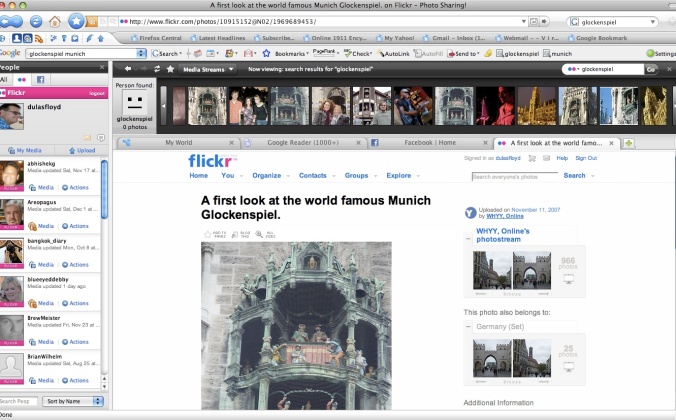
I just download the latest version of Flock. If you interact with a variety of blogging, media or social networking sites, this the best browser I’ve seen. While I had been using an old version of Flock, this newest version is better integrated than anything I’ve seen yet.

Facebook junkies can now send gift icons to their friends and donate to charities at the same time. While the early adopting may be slow, I think this is a cool way to integrate supporting non-profits into our social networking experiences (as opposed to siloing that experience on some offshore site. Now I am wondering when the IRS is going to have cash icons that we use to pay our taxes.

I think I just figured out why I got Leopard for my mac. You can preview multiple documents by simply tapping the spacebar. That’s right, simply highlight the documents you’re want to preview in the Finder and then tap space bar. Viola!
Thanks Lifehacker!
© 2026 Pilgrim Notes
Theme by Anders Noren — Up ↑


