Pilgrim Notes

Reflections along the way.

Page 27 of 72

Customer Service Disaster at the Rocky Mountain Chocolate Factory

If you’re passing through the Bellaterra/Huntington Beach area in California, you might want to watch out for the Rocky Mountain Chocolate Factory. The Consumerist hits them with a downright horror show story in customer service denial.

Not sure if I can bear to even eat chocolate after that story.

Update: The COO of Rocky Mtn Chocolate Factory called and apologized to the lady. Rock on! And hand me another chocolate bar.

She'll Be Coming Round the Mountain

She’ll be comin round the mountain when she comes,
She’ll be comin round the mountain,
She’ll be comin round the mountain when she comes.

I’ve heard that song over and over and over through my life. Seems like a silly song but there’s something in the repetition and rhythm that makes is stick out in my mind. At different times in my life, the song has brought to mind different images.

This morning it makes me think of the person who caught in a particular trial. In the midst of their frustration they exclaim, “I’ve gone around this mountain several times. I wish I could learn my lesson and move on.” I know that person because I’ve been that person more than once.

Whether in the areas of finances or job or friendships, I’ve often felt like I was circling, re-circling and circling the mountain yet again. Driving up the side of a mountain on a swtichback road has a similar feel. I see the same sights again and again, but each time I see them from a higher altitude.

It might just be that when we feel like we circling round the mountain again and again that we could be repeating a pattern but at a higher altitude each time. So we’re not really in the same place, we’re actually moving higher and higher.

Sometimes I’ve drawn two diagrams on a board to demonstrate the way many Christians perceive the spiritual life. Some might think of it as a gradual incline leading higher and higher and higher to a peak, which is the place of glorification. Depending on their tradition, this promise of glorification may happen before or after death.

Other Christians might think of their life more like a line pointing up breaking through a barrier to reach a plateau where the life of faith is lived in fullness. A key event marks this breakthrough—usually either their initial salvation experience or a secondary experience of the Spirit’s infilling. Their “testimony” normally will consist of discussing the events prior to the moment of breakthrough and the dramatic impact the breakthrough had on their life.

I think both of these pictures are helpful in thinking about different aspects of a spiritual journey but I might also suggest that, “She’ll be comin round the mountain” offers a third and valuable image as well.

The image of a circling a mountain with a gradual incline captures the image of repeated patterns in our life. I would suggest that one aspect of growth in our lives can be characterized by a series of repeated patterns.

One way to explain this understanding is to consider the seasons of the year. Each year we pass through spring, summer, fall and winter. Then the seasons are repeated. And again. And again. And again throughout our lives.

If we don’t move every year, this repeated pattern of seasons in our region will be layered into our memories. Certain smells, sights and experiences of the different seasons will bring back memories of past seasons. Driving with my window down in late spring often takes me instantly back to 1982 and my senior year in high school.

We may associate certain activities with certain seasons. For example, we may connect vacations with summer; football with fall; hot chocolate with winter; and flower gardens with spring. But we don’t have to do the same thing every season.

Some years, I may chose to follow the birds and fly south in the winter. Other years, I may head north to a snowy mountain and ski slopes for the winter. In other words, I experience the repeated pattern of the season, but I am free to improvise my response much like a jazz musician might do with a standard.

In addition to the repeated patterns, we impose a calendar upon our year with repeated celebration or patterns. Many Americans might celebrate Thanksgiving, Christmas, Easter, and the Fourth of July regardless of their religion.

Add to the big four a series of lesser holidays and we have a repeated holiday in most months of the year. Add to those celebrations the personal celebrations in the lives of our friends and families like birthdays and anniversaries. Then add the weekly worship services, yearly VBS, graduations, weddings and more.

Soon we discover that our life is filled with repeated patterns.

I would suggest that we learn through repeated patterns. Just as our calendar reflects this rhythm, our personal lives reflect seasons of learning. There are times when we may actively learn and other times when we may actively create and other times when we may focus on serving or relationships or prayer or mission’s work.

These seasons of intensity and focus may repeat again and again. But each time, we may remember our previous experiences and lessons from the past to play upon our experience now.

We may also pass through repeated seasons of joy and sorrow, struggle and victory, grief and comfort, conflict and forgiveness and so on. But just like the jazz standard or the repeating seasons, we don’t have to respond to the same rhythms in the same way.

One year during lent, I meditated upon the joy of the Lord. This taught me the pattern of joy in suffering. When I find myself in the midst of a repeated trial, I am free to choose a different way to respond. Jack Taylor once told the story of his son growing through grave financial difficult. In response, the family had a celebration.

This decision to alter their response to something depressing and discouraging could then give them fresh eyes and perspective to the struggle and possibly see new opportunities ahead.

So today, I think I’ll rejoice that, “She’ll be comin round the mountain when she comes.” I may think I’m coming back round the mountain, but I know I’m moving upward to a place of glory. So I can improvise respond in new ways, bring new expectations to this similar season.

And even in the midst of my current circumstances, whether good or bad, I can rejoice and know that my faithful Savior is leading on the path. And in the end, he present me as blameless before the Father.

Patterns, Progress, and Lifespans

I’ve written before about the idea of how each of our lives represents a span of time that we called a Lifetime or Lifespan. In one sense, each of us live within a particular time because we have particular memories and particular visions. We move in time between memory and vision. This particular movement between memory and vision unfolds in our language, our responses, our actions in the world around us.

If I remember being bit by dogs in the past and I expect that encounters with dogs in the future could result in being bit, then I will have specific responses to the dog in front of me right now that will be different from someone with a differnt timespan of memory and vision in relation to dogs.

But our lifetime is not determined in this sense because surprises can happen. One friend told me that she had a fear of dogs her whole life. While visiting family, she was sitting a bed when the family dog slipped and started to fall from the bed. She instantly responded by catching the dog to break the fall. This act changed her response to dogs. In a single action, she changed and became someone else.

We live within one time, but some-times we can step out of time and change, entering a new time (new memory and vision).

With that said, I do think that there are patterns common to all lifetimes (or most lifetimes). James Jordan suggests that we move in patterns between faith, hope and love. This is a pattern that also appears in Scripture as the movement between Priest, King and Prophet. While I will touch of some of his ideas in the posts about this theme, I will not attempt to develop his idea completely, but will explore some aspects. If you want to see his full thoughts, read From Bread to Wine (see the catalog on Biblical Horizons).

Now to consider patterns think of childhood. There are phases of dependence and trust, growth and exploration, and times of expressing self and defining relation. These phases may not be as clear cut as I lay out here but they do happen and there is a bit of repitition at different ages.

The newborn is totally dependent for clothing, food, care and so on. This is a phase of absolute dependence; an initial phase of trust or faith. While a child is dependent through adulthood, there are some points of particular dependence such as when their first born. Another time of intense dependence is when they first do away to school.

They leave home and now must trust a figure outside the home to function as a surrogate parent. Just of their dependence on the parent helped shaped their identity, this dependence on the surrogate (such as Kindergarten teacher) will also impact their identity. Rules of the classroom and rules in grammar, math and so on become foundational for them to make sense of this new world.

Newborns grow into a toddler phase characterized by growth and exploration. They discover their fingers and toes. They move from sitting/rocking to crawling to walking. They grow from making noises to forming initial words. Some early development is taking place in their body and mind. They are learning and a very early form of reasoning is displayed.

This season of growth and exploration will happen again around 9-14. This is when they shift from being a boy to being a young man and from a girl to a young lady. They become aware of differences and constrasts between family, the sexes, the neighbors and us, the kids at school and our family. Using their developing reasoning skills, they are more willing to argue with other kids (and with parents).

Another phase can be seen in the 3-4 year old as they tell mommy again and again how much they love her. They may become clingy to one or both parents. They start asking “why” hundreds of times a day (which prepares them for the rules phase).

When a child moves into teenage years, the “why” question becomes more pronounced. Their asking harder questions and getting ready to do more reasoning, but their also extremely emotional. They may begin flirt with the opposite sex. They move between highs and lows with sudden emotional outburts. They’ve experienced similar passions at a younger age but these were directed to parents. Now their emotions are directed outwards to friends and potential loves (as well as enemies).

While the phases may not be so clear cut, there repeated seasons where children are totally dependent, form identities in relation to authority figures (and eventually in relation to peers), experience dramatic growth and development, ask questions, shift from thinking to feeling, learn new rules, apply old rules in new ways, break rules. And so on.

The child is growing and repeating patterns again and again–developing their lifetime (memory and vision) which will shape their ongoing formation in adult years. At the same time, there are always possiblities along the way for dramatic invasions from outside their memory and vision that will shape their lifetime for both good and bad.

These pattern of rules, relationships, reason, emotions, growth and so on occur over and over throughout our lives. So in one sense, our lifetime is similar to the circular motion on a clock. Repeating hour after hour. At the same time, unexpected events can alter the cycle or challenge us to step outside one cycle and enter a new rhthym. An retired widower may suddenly decide to learn the the blues and travel around the world.

We are free to change within our lifetime. This freedom to step out of one cycle and into another is part of what makes us human. And yet, even as we step between cycles, we will still face internal and external periods focused on identity, relationships, rules, growth, questioning, stories, and so on.

The Gift of the Poets

In his poems praising various people, Bobi Jones writes a poem to the poet. The Celtic poets use the discipline of constant praise to offer thanks, challenge status quo, offer social commentary and more.

Such a praising of the harvesting of the keeping–the baby’s life,
The lad’s life, the old man’s life behind your door.*

Bobi realizes that the poet connects the generations. And for a people crushed either personally or as a nation, the poet transforms that pain:

And you turned the blows as well into a praise of living.

These Welsh poets have personally gifted me with the habit of praise, of sight to praise and as Bobi says, of learning to transform the struggles and blows in this world into a “praise of living.”

The poet offers everything–the very essence of his life–in service to the gift.

From your immense Preselau** you raised teh walls of your belonging
And in the presence of its sun’s rafters you consecrated your laughter’s values:
You made your people one in a mystery sea.
You included us in your family. You sang
The white guts of your praise and your being, and you planted
Your leaves in our back-garden in proper robes like a choir.

* – Bobi Jones writes poetry exclusively in Welsh, so when I quote him, I am quoting Joseph Clancy’s translations.

** – Preselau or Presely Hills, a place in Wales (whose location is in question). I think this poem is using it as a way of identifying the land of the poet (which like the ancient Hebrew is connected with his salvation).

Modern Sickness, Disintegration and Nostalgia

While searching for articles and books on Giambattista Vico yesterday, I ran across a great 1997 interview with Lois Dupre from Christian Century on “Seeking Christian Interiority.” Dupre laments the loss of a metanarrative in this late modern world: “We experience culture as fragmented; we live on bits of meaning and lack the overall vision that holds them together in a whole.”

This “absence of a defining unity” cause us to feel “lost in a disconnected universe.” While some “postmodern” writers rejoice in the loss of an overall narrative, most of us struggle with the need for some meaning that brings coherence to our lives. Christendom offered such a coherence, but that integrated world died with the middle ages and the modern world has moved farther and farther from looking to Christianity as a source of integration.

Dupre suggests that as the awareness of what the modern project has realized, people struggle with a yearning for something from yesterday.

“They feel the fragments present to us must somehow be united in a manner that modern culture fails to accomplish. Hence they turn to models from the past. Some join ultraconservative religious or political movements, or they lose themselves in mystics of earlier times as if no cultural distance separated us from the past. Such complete reversals that attempt to abolish modern life are, I think, inauthentic ways for trying to achieve the integration our time needs.”

While we may have some nostalgia for the Christian past, Dupre warns against trying to “reinvent a Christian ‘tradition’ (mostly intended for the masses) for social or political purposes.” So how do we respond to the crying need for an integrated vision of the world?

In this world between worlds, Dupre finds inspiration from another time between times: the age of Augustine. The Classical world was ending and the Medieval world was beginning. Augustine finds personal integration through faith in Christ rooted in the Christian Community. This integration works outward and finds ways to synthesize the pieces of his fragmented world such as Roman civic morality and Neoplatonic philosophy.

Dupre sees this integration as working outward from personal to local to cultural. This is a slow process and in one sense comes to define the new world. I think we see a similar attempt in integration in the shift between the Medieval world and the Modern world in the Reformation and Renaissance.

As we find ourselves in a world between worlds again, Dupre offers humbled approach to transformation. Instead of triumphalist declarations of restoring Christendom, he suggests our best steps forward in for true personal integration based on faith rooted in the Christian community. We must begin with a deep and profound personal integration. This is simply an individualistic interpretation of Christian faith, but a an experiential Christian faith that springs from the Scripture and community of believers. It is deeply relational.

Working outward, we must learn and cultivate an inner integration of the pieces of the modern world. Instead of reaching backward, we trust the Providence of God and work from our current estate forward. Only then, can we begin to think about community and cultural transformation. More on that later.

Stories upon Stories upon Stories

The Bible is not simply one story but many stories. And these stories form patterns that are repeated again and again. For example, the creation story appears in Gen 1 and Gen, but then variations of the creation story reapper throughout the scripture in places like Job, Proverbs 8, John 1 and Romans 1. Each story reflects a different aspect of the pattern.

Some of the many stories appearing in the Scriptures include:

The story of the Law

The story of Sojourn

The story of Slavery and Exodus

The love story between a Groom and Bride

The story of Father’s and Sons

The story of rebellion and redemption.

These are just some of the many stories that appear, reappear and reappear again. All these stories might and probably would have seem disconnected. But Jesus comes and fulfills/embodies every story. All the stories are flowing in and out from Him.

These stories might also be thought of as bardic songs. The ancient Celtic bards would sing songs of adventure and love and nature and war to the people. Their songs not only entertained but also helped forge a common memory of the tribe.

As we read the story (and sometimes realize we are acting in some of the story patterns), we also discover that we are being forged into a common memory of a family that spans time from beginning to end.

Hans Urs Von Balthasar speaks of the complexity of interwoven stories. He calls this a “symphony,” ” a dance fo sound.” Here are few of his thoughts on symphony from the classic treasure, Truth is Symphonic – Aspects of Christian Pluralism.

In his revelation, God performs a symphony, and it is impossible to say which is richer: the seamless genius of his compositions or the polyphonous orchestra of Creation that he has prepared to play it. Before teh Word of God became man, the world orchestra was “fiddling” about without any plan: world views, religions, different concepts of the state, each one playin gto itself. Somehow there is the feeling that this cacophonous jumble is only a “tuning up”: the A can be heard through everything, like a kind of promise. “In and various ways God spoke of old to our fathers by the prophets…” (Heb 1:1). Then came the Son, the “heir of all things,” for whose sake the whole orchestra had been put together. As it performs God’s symphony under the Son’s direction, the meaning of its variety becomes clear….Initially, (the musicians) stand or sit next to one another as strangers, in mutual contradiction, as it were. Suddenyl the music begins, they realize how there are integrated. Not in unison, but what is far more beautiful–in sym-phony.

Rhiannon and the Pursuit of Woman

Bobi Jones captures the one of the Welsh myths from the Mabinogion in verse with his poem Rhiannon. This love story centers on the pursuit of a woman by a man over hills and into mist. No matter how fast his servant or his horse travel, Pwyll cannot reach the object of his affection. In desperation, he calls out to her and she stops and tells her tale and ends up marrying him.

When he beholds this vision of beauty, Pwyll proclaims,

She was dew: if the mournful sun should dare
attempt to lure her away, it would not deserve to dawn.

Then Jones’ poem (in Pwyll’s voice) describes the rapturous vision of Rhiannon by saying,

To see her like precious life fleeting away,
Nervous maidenhood raining along her shoulders
And everyone slaking his thirst in watch her:
As smoothly as blood in a vein she glided
On the white stallion-heart through the morning mist.
How shall one sing her purity?…Not like one
Moving in the outer world was her going,
Unless like a breeze softly wooing the ear,
Like a shadow of waters slanting the mind.

Is she a goddess? Is she a human? Has she crossed over from a thin place? Reading Jones’ poem the other day, I was struck by how vision of Rhiannon mixes physical attraction with spiritual longing. In the woman, he beholds something, someone that touches him deeper than simple lust for the other.

In Rhiannon, Jones’s stirred me to think of a vision beyond the Celtic myth to the pursuit of woman. Why do men respond the shape, movement, touch, smell, and voice of woman? The powerful warrior is powerless before such beauty. The intellectual falls dumbstruck in the presence of woman. Is this not part of the mystery of Song of Solomon and the passion between David and Bathsheba.

Then as I reflected on this response to the beauty of woman, I was moved by the decision of God to reveal his relationship with humans in the context of man pursuing woman. This pursuit is not the violent conquest of predator but of the Prince running toward His beloved in the folds of a misty morning.

In the midst of the pursuit, He speaks and His words capture the heart of the maiden.

With all our books about pursuing God and our songs about our love for God, we must not forget the real story. Our feeble responses and pursuits are but dim reflections of a God who runs to His bride. Though she seems to elude Him, He runs straight through the curse of sin and death to pursue His beloved. Then He speaks but a word and she, we, His people are overwhelmed by a love beyond knowing.

Again and again we fall back into His faithful loving arms, and by His grace we are learning to trust the Lover who defines the eseence of love by selling all that He has (giving up His life) to purchase the pearl of great price.

Tomorrow when I arise, I would do well to remember Jones’ poem Rhiannon and expect the Lover of my soul to pursue me through the hills and valleys of my wandering life.

Fashion Crimes in Obama's Campaign

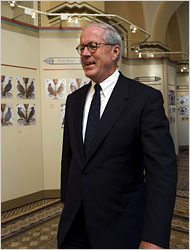
Did Obama’s VP advisor Jack Johnson fall victim to a fashion faux paus? I don’t think so, but the NYT headline begs for a story on fashion crimes:

Obama Aide Quits Under Fire for His Business Ties

Of course from the picture above, his business tie does look pretty bland.

I Got a Free Apple TV Using My Debit Card

As it turns out my credit union, the Knoxville TVA Employees Credit Union awards points for using the debit/credit card. I checked the Bonus Check Card site last week and found out I qualified for a $250 Best Buy gift card (or a free Apple TV).

I figure that if my credit union offers these points, your credit union/bank might as well. So I encourage you to ask or visit your bank’s website to find out if they offer any incentives for using the debit/credit card.

« Older posts Newer posts »

© 2026 Pilgrim Notes

Theme by Anders NorenUp ↑