Pilgrim Notes

Reflections along the way.

Page 11 of 72

The Posture of Love

The disciples gather around Jesus in the upper room. Before the meal begins, Jesus surprises and disturbs his followers by laying aside his garments, kneeling down, and washing their feet. Peter is shocked. In spite of his objections, Peter still submits to Jesus. All the disciples yield to the washing, blessing, cleansing act of Jesus.

Then he gets up, restores his clothes, looks at them and says, “Do you understand what I have done to you? You address me as ‘Teacher’ and ‘Master,’ and rightly so. That is what I am. So if I, the Master and Teacher, washed your feet, you must now wash each other’s feet. I’ve laid down a pattern for you. What I’ve done, you do. I’m only pointing out the obvious. A servant is not ranked above his master; an employee doesn’t give orders to the employer. If you understand what I’m telling you, act like it—and live a blessed life” (John 13: 12-17, The Message).

Let’s pause this story for a moment while I tell another story. A love story. Not a typical love story. At least, not the typical love story we’ve grown up hearing. It’s a story about a people living outside of love, outside the community of the faithful, outside the city. A people living by the dump, Gehenna. A people used to breathing the toxic fumes of society’s waste. It’s a people who have completely forgotten that they are beloved.

God comes to these tax collectors, prostitutes, demoniacs, and he eats with them. He drinks with them. He loves them. In the person of Jesus of Nazareth, the Son of God comes to His people to love and heal and embrace them. But they are so far in the dark that their initial response is not to turn toward Him but away from Him. He comes into the lives of the dark people, the forsaken people, the abandoned people, the lost people, and loves them fully, completely.

His love is unpredictable and everyone misunderstands. Jesus keeps loving, confronting, and immersing them in the surprising shape of His love. He is loving this mixed community into family. He pursues His people like a groom running toward His bride. Eventually, they behold the complete form of His love, and much to their surprise it looks like suffering and death.
People tell stories about the pain of lost love, forsaken love, unrequited love, but the most painful love story is the complete unveiling of true love. It is the deepest sorrow and the deepest joy. In the mystery of the Love of Jesus, death and life are intertwined and reversed. Sorrow becomes singing. And by the Spirit of Resurrection, death gives way to Life Unconquerable. This is the love story that gives birth to all true love stories.

We return to the twelve, sitting around Jesus, yielding to His service. Before His death, before His crucifixion, He gathers the twelve together. And he kneels before them. If not for the revelation of this action in John’s Gospel, the horror of this act seems almost unspeakable. Consider for a moment the implications of such an act.

An immoral woman kneels before Jesus and washes His feet with her tears, wipes them with her hair, kisses them with her lips, and anoints them with her perform. Jesus acknowledges her act of adoration and blesses her, “Your sins are forgiven. Your faith has saved you. Go in peace.” He speaks as the true king. He speaks as the Son of God. He speaks as the Creator and Redeemer of the World. “Your sins are forgiven. Your faith has saved you. Go in peace.”

The posture of kneeling is the posture of submission before a ruler, and adoration before a god. Kneeling, bowing is a significant act of humility and worship. The second command warns against bowing down before false images of any kind.

Jesus kneels before the disciples.

What could this mean? How could the Creator of the World kneel before His created? How can we even begin conceive of the humiliation? We may miss the deep humiliation of the cross if we cannot see the unspeakable humiliation of Jesus kneeling to wash His disciples feet. He assumes the posture of the supplicant.

At first, the disciples are distraught and confused with Peter speaking as usual on behalf of the rest, “No Lord!” But Jesus says, “Yes and Amen.” There is no choice. Peter must submit. The Lord of Creation kneels before Peter and washes His feet.

Jesus does not violate the second commandment because these are not false images, they are true images. Created in His image, they’ve been disfigured by sin, but they are still imaging the Lord. He gathers, cleans, restores, heals the images of God. He begins in love, “For God so loved the world that He sent His only begotten Son.” And now He ends in love, “Having loved his dear companions, he continued to love them right to the end.”

He loves them completely. This kneeling is but a foretaste of the deeper humiliation to come that will also express His love, His Father’s love. Jesus reveals the love of the Father in His every word, His every action. He also reveals the pattern, the shape, the form of love in His complete person. Love is Word, Body, Act. His whole person patterns, images love.

As He restores these broken images, He tells them, “Do you understand what I have done to you? You address me as ‘Teacher’ and ‘Master,’ and rightly so. That is what I am. So if I, the Master and Teacher, washed your feet, you must now wash each other’s feet. I’ve laid down a pattern for you. What I’ve done, you do. I’m only pointing out the obvious. A servant is not ranked above his master; an employee doesn’t give orders to the employer. If you understand what I’m telling you, act like it—and live a blessed life.”

He also says, “Let me give you a new command: Love one another. In the same way I loved you, you love one another. This is how everyone will recognize that you are my disciples—when they see the love you have for each other.”

Jesus enfleshes the shape of love, in Word, in Deed. In serving, in humbling Himself, in honoring His people. In life, in death, and in life eternal. Just as he gathered those twelve unto Himself, He is still gathering, still comforting, still healing, still cleansing, still loving. He invites us into His action.

From the vantage of kneeling, we see the other person in a whole new light. The light of Jesus cleansing, glorifying, beautifying love.  In Him, the world is made new. In Him, the broken is made whole. In Him the abandoned is welcomed. In Him, the mournful finds joy. In Him, the image is restored.

So we serve and wash and even kneel in Him by the power of His Spirit. We are becoming lovers His love. And His love is sending out into all the world to love, and embrace and reconcile all things to Him.

* – All Scripture taken from The Message. Copyright (c) 1993, 1994, 1995, 1996, 2000, 2001, 2002. Used by permission of NavPress Publishing Group.

Falling and Rising (Psalm 3)

David is falling. The crack in his house fractures into an ever-widening crevice, and he is falling, falling, falling into that dark pit. Civil War splits his kingdom as Absalom, his son, occupies his throne, claims his title, and promises to usher in the kingdom that David could not. Lifelong allies betray David, offering allegiance to Absalom.

An age ago, he took Bathsheba and sent Uriah to his death. This fault line struck to the heart of his own family and now his own kingdom. Everything that can shake is being shook. David is falling.

1 Lord, how they have increased who trouble me!
Many are they who rise up against me.
2 Many are they who say of me,
“There is no help for him in God.” Selah*

His enemies are rising and David is falling. Falling, falling, falling into the grace of God.

3 But You, O Lord, are a shield for me,
My glory and the One who lifts up my head.
4 I cried to the Lord with my voice,
And He heard me from His holy hill. Selah

The depth of YHWH’s grace reaches deeper than the depths of David’s sin. David falls into the grace of God. As his kingdom comes crashing down, it falls into YHWH’s protection.
David lifts up his voice, “Shield me, Glory me, Head me.” YHWH lifts up David. In the covenantal faithfulness of the Lord, David can rest.

5 I lay down and slept;
I awoke, for the Lord sustained me.
6 I will not be afraid of ten thousands of people
Who have set themselves against me all around.

In the midst of surrounding enemies, he can fall back into the trustworthy arms of the Lord. He lays down. Sleeps. Arises.

David is acting out the pattern of God’s beloved.

Laying. Sleeping. Awaking.
Dying. Resting. Arising.

In his prayer, in his bones, in his heart of hearts, David acts out in an imperfect way the perfect and faithful response of Jesus to the Father. For Jesus lays down in the midst of His enemies. Falling. Falling. Falling into the hands of sin, evil, hatred and death. Jesus humbles himself before the Father, before humanity, before all creation, and dies a criminal’s death, bearing the sin of David and the world. His body lies in the tomb until the Father calls Him forth by His Spirit. The Father exalts Him above every name, every power, every thing in all creation. At His exalted name, all will fall and confess, “Jesus as Lord.”

Dying. Resting. Arising.
Laying. Sleeping. Awaking.

Every night we join David in rehearsing the pattern. We lay down in the grace of God. We sleep in the grace of God. We awake by the grace of God. Every night we rehearse the pattern of humiliation and exaltation, of lowering and rising, of death and life.

We are called into cross shaped lives. We are called to this fellowship of humiliation. Like David, we must also walk in the places of naked trust: the valley of the death. Like David, our enemies will surround us. Fear will raise its voice. Condemnation will shout aloud, “There is no help for him in God.” Voices of discouragement will surround us.

From the place of humiliation, we look up to our Savior, “Lord, Shield me, Glory me, Head me.” In David, in Christ, we find our prayer,

7 Arise, O Lord;
Save me, O my God!
For You have struck all my enemies on the cheekbone;
You have broken the teeth of the ungodly.
8 Salvation belongs to the Lord.
Your blessing is upon Your people. Selah

Even as we lift up our voice, the Lord lifts up our heads. He shields his people in embrace of His covenantal faithfulness. Nothing can penetrate the encircling love of God. We rise with Christ, and learn to trust, knowing one we will truly lay down to rest. And together we will truly arise into the dawn of His eternal blessing.

* Scripture taken from the New King James Version. Copyright 1979, 1980, 1982 by Thomas Nelson, inc. Used by permission. All rights reserved.

Thoughts on The Tree of Life by Terence Malick

What happens when you’re world comes crashing down? You show up for work and the boss sends you and half the department home: laid off. Or you come face to face with a horrible darkness in your own heart that has and is damaging relationships all around you. Or your beloved family member dies suddenly, and you wonder if God even cares.

There are moments in life that change all the other moments in life. Suddenly the frailty of our world, our beliefs, our relationships stand in naked clarity, and we shudder. These moments of suffering, of mourning, of anguish can make time feel as though it has stopped.

Struggling through the grief of death and loss, memories flood our hearts in no particular order. Or we may find ourselves fixated on one singular memory that shuts out all other memories. It is difficult to move, to think, to find solace. Just moving through the day feels like we’re pushing through a thick, choking smog that blinds our sight and smothers our lungs. If you’ve ever felt grief or depression or deep anguish, you know some form of this struggle.

Just after the opening moments of the film, The Tree of Life by Terence Malick, we discover a death. The mother (Mrs. O’Brien) breaks down weeping after receiving a letter. Mr. O’Brien answers the phone at a landing strip and is overwhelmed by the news he hears. Their son Jack lights a candle and stares numbly forward. They all three have come face to face with the death of their son and brother.

This sudden death immerses them and us into one of those moments that impacts all other moments. The outer world of schedules and events and daily life moves into the background as the inner world of grieving and questioning and remembering takes the stage. Eugen Rosenstock Huessy calls this “lyrical time.”

Time is no longer chronological. Just like our memories and our feelings don’t follow some chronology. They move and drift in unexpected ways. A smell takes us back to fifth grade in an instant. Seeing an old picture may awaken a flood of memories. This films immerses us into lyrical time through the death of a son and brother, the encounter with personal darkness, and the loss of a job.

We experience the memories and life of a family but at the same time, we experience the deep questions that plague the human heart, “God are you there?” “Do you care about us?” “How could you let this happen?”

The opening shot of the film sets this stage for this questioning with God’s response to Job’s questioning of his suffering and God’s righteousness. As Job finishes his rant against God for allowing him to suffer so completely, he asks, “Does not he see my ways
and number all my steps?” (Job 31:4). After one of Job’s friends (Elihu) speaks on and on about Job’s failure and God’s righteousness, suddenly a whirlwind interrupts and God speaks. “Who is this that darkens counsel by words without knowledge? Dress for action like a man; I will question you, and you make it known to me” (Job 38:2-3). And then we hear the beginning of God’s response to Job, which Malick uses for his opening shot:

“Where were you when I laid the foundation of the earth?
Tell me, if you have understanding.” (Job 38:4)

If we read Job 38-41, we hear God challenging Job out of the whirlwind. He never answers Job’s complaint, but he challenges Job’s assumption that he could even understand the ways of God by asking Job about the creation of the world and all manner of mysteries throughout the cosmos. “The Tree of Life” draws from Job in the opening shot, in a scene from a church sermon and in a myriad of images from the creation of the world to all manner of mysteries throughout the cosmos. Malick does not explain that he is imaging Job.

But if we simply read Job, we simply a striking parallel to many of the images that Malick chooses to show. His visuals are breathtaking, beautiful and would seem disconnected if not for the questions at the heart of a family facing death. We are thrust into the story of Job through the O’Brien family. But we are also thrust into the heart of Eden.

The title of the film confronts us with another story, a story of a garden of innocence and a story of two tree: the tree of life and the tree of the knowledge of good and life. As Alexander Schmemman explained in the “For the Life of the World,” The tree of life is pure gift and humans receive and enjoy in the goodness of God. The “tree of the knowledge of good and evil” is not gift. Yet humans take it. They grasp what is not gift and human history becomes a story of human grasping.

This anguish is played out in the life of Jack. He says that his mother and father wrestle within him. As he remembers and reflects on her, he rehearses a life of grace, of gift, of love, of joy. The father on the other hand, models to Jack that he has to be tough and take what is his. The two trees struggle in Jack’s heart. At one point, he takes some lingerie from a women when she is not at home and it is as though Jack has eaten the fruit of the tree of knowledge of good and evil.

Suddenly, he is thrust out of the garden of Eden and comes face to face with his own darkness. He longs to return to innocence but instead mistreats his brothers, threatens his mother and tells his father that he knows the father wants to kill him. Jack is dying in his world of taking and of self hatred. He longs for a return to innocence.

He is not forsaken, but grace makes a way to restore him and his relations. As Jack’s memories of youth, of innocence and experience, of laughter and play flood his mind, we see a taste of the manifold memories from childhood that shape us, struggle within us, and resurface in the midst living.

This film is not to be watched like a puzzle to solve, but more like an unfolding encounter. We feel Jack’s joy and suffering. We lives inside the family. Yet we also encounter the mystery of a cosmos that is beyond our grasp and a Creator who is beyond that. This same Creator encircles us with grace, with wind and water and circles of love and joy and grace.

The great mourning that paralyzes Jack and his parents seems to resolve in worship. This is not a blind worship, but a letting go in trust. In series of images on a beach, we see some sort of family resolve and embrace. And then in a few images later, we see the mother opening her hands in release and possibly worship.

Malick does not try to fill in all the dots. Like the mystery of Job, he does not try to provide an answer for suffering, for death, for grieving. But he does reveal uplifted hands in apparent love and trust.

If you choose to watch this film. I would suggest approaching it like a poem. Let go of trying to solve or understand everything. Allow the images and sounds and clips of narrative to encounter you. And it may be that as you rehearse and revisit these images through memory, a richer story of life and love and trust will unfold within you.

Unfinished Verse to My Father

Here are a few thoughts in memory of my dad.

Unfinished Verse to My Father

To save money, St. Mary’s
no longer rings the Angelus bells.
Three times each day I hear silence.
– David Citino

The silence of absence can be deafening.
On Sunday evenings when we gather, we break bread, we tell stories,
I hear, see, feel his absence.
In the echo of voices,
his silence silences me.

Throughout my childhood,
he brought a new story home
every day.
As we chewed our baked chicken
and buttered our bread
he’d fill our imagination
with dangerous criminals, car chases,
and captured robbers.
And sometimes he’d still
recount those years in
New York, following Russian spies
to the gym, to the tea room, to the pier.
As he waxed on,
no one spoke.
If I wanted the potatoes, I pointed.
No one spoke.
The meal moved forward with gestures,
and we listened to the adventures of the storyteller.

Now the thundering silence of his absence
echoes through me.

His words wrap around my bones,
circulate through my blood,
and burn in my heart.
I hear them when I pray
over the meal.
I feel them when I reach
for the butter.
I see them when I look
around the table.
The silence of absence can be deafening.

Walking Away

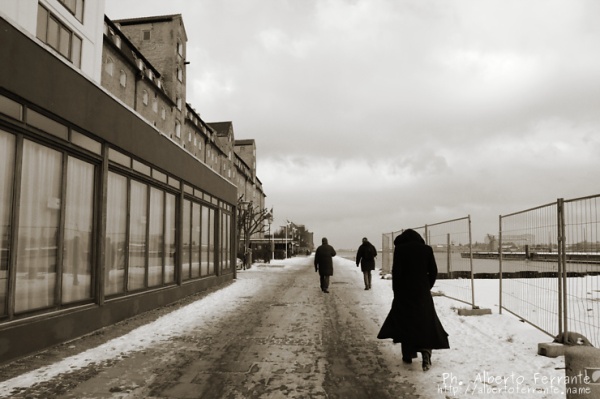
Walking Away In the Cold (picture used by permission)

On May 8th, my friend Jack King delivered a sermon about the disciples on the road to Emmaus. He talked about how they are walking away from Jerusalem. That powerful image stuck in my mind, so I tried to write a meditation in responde to Jack’s sermon. 

They’re walking away.

Walking toward Emmaus, they leave Jerusalem behind.

Three days ago they still burned with hope that Messiah had come. They still believed the Kingdom of God was at hand. They still believed the glory of God’s people would soon be restored; the oppressive rule of Rome was coming to an end; the false king Herod would soon be deposed. They believed Jesus would restore the land, the Temple, and the people. God’s kingdom was breaking into their midst, and they were filled with joy and hope and anticipation.

Today they’re walking away.

Jesus died on the cross as a lowly criminal. His bold proclamations died with him. Their faith died as well.

Walking toward Emmaus, they leave behind faith and hope and love. They leave behind dreams that rotted on the vine. They leave behind promises that hang empty in the air. They leave behind a community of disciples that now lies in ruin. They leave behind everything that gave their life meaning.

Today they’re walking away.

An ache grips their throat choking down through to the bowels. It feels as though they’ve eaten a poison that kills from the inside out. They cough out dead words of dead dreams. They look through dead eyes at a dead world. What do you do when all hope is lost?

Walking toward Emmaus, they leave behind the future and search blindly for a past that is gone. Once you’ve tasted something so wonderful, so beautiful, so hopeful, where do you go when it dies? You can’t go back to what you knew before. So you’re stuck in between a dead past and hope less future.

Today they’re walking away.

They walk and move and breathe in the numbing emptiness of limbo.

Some of us know the road to Emmaus all to well. We’ve known the excitement of God’s people hoping and believing and experiencing His touch, but we’ve also known the loss of hope, the death of dreams, the sense that God left us, forgot us and possibly even abandoned us. Some of us are walking alongside these disheartened disciples as they leave the Holy City.

Walking toward Emmaus, the Risen Jesus joins his disciples in their unsightly death march. His disciples have lost hope, lost faith, lost vision. They’re leaving Jerusalem. They’re walking away. And Jesus is walking with them.

Even when his disciples are faithless, He is faithful. He walks beside. He hears their complaint. His listens to their groans. He even asks them questions.

In the fullness of time, He speaks. He rehearses the story of God in the midst of His people. He reveals the goodness of God in the midst of dead lives, dead dreams, dead people. Again and again and again, the Lord speaks His Word to His people in distress, in blindness, in darkness. Again and again and again, His Spirit quickens faith in their hearts.

Noah hears this Word amidst his blind and deaf world and builds an ark that will be the beginning of a new world. Moses hears the Word while wondering among the Midianites. Samuel hears this Word when Israel’s light is flickering and about to go out. David hears the Word in the tomb of the cave. Ezekiel hears the Word on the banks of the River Chebar in Babylon.

Again and again and again, the Word resurrects the dry and dead bones of God’s people. Many times, God’s people are not seeking, are not looking for Him, and are not even aware of Him. Their hope and faith have long since died. The Word of Life overcomes the darkness and quickens the dead to life.

Today Jesus is walking away.

He walks away from the Holy City to join his weary disciples in their flight from God’s work. He speaks. The ache of death fades as faith sparks afresh. Anticipation burns within. Suddenly, they can see. The Risen Lord stands among them, serving them, feeding them, sustaining them.

Walking toward Emmaus, we’re leaving behind the grand expectations we had for God. Stripped of our confidences, our conditions, our conclusions, we encounter the Risen One. He is walking with us. He is listening to our complaint. He knows our frustration and confusion.

At the outskirts of Jerusalem, we hear His strange and wondrous Word of God. And who knows? As we follow the Voice of this Holy Shepherd, we may end up walking along side those who left the Holy Spirit and are waiting in darkness for the Word of Life.

We Used to Wait

Izaak read Change and Boats and thought about this song. Interesting connection between speed and waiting and memory and life. Believe it or not this stuff about speed and rate of change is all going somewhere at some point. Where? Not totally sure. Right now, I’m listening, watching and still waiting. Sometimes learning new things requires that we stare.

Here are the lyrics to the Arcade Fire’s “We Used to Wait.”
I used to write,
I used to write letters I used to sign my name
I used to sleep at night
Before the flashing lights settled deep in my brain

But by the time we met
By the time we met the times had already changed

So I never wrote a letter
I never took my true heart I never wrote it down
So when the lights cut out
I was left standing in the wilderness downtown

Now our lives are changing fast
Hope that something pure can last

It seems strange anekatips
How we used to wait for letters to arrive
But what’s stranger still
Is how something so small can keep you alive

We used to wait
We used to waste hours just walking around
We used to wait
All those wasted lives in the wilderness downtown

oooo we used to wait
Sometimes it never came
(oooo we used to wait)
Sometimes it never came
(oooo we used to wait)
Still moving through the pain
(oooooo)

I’m gonna write a letter to my true love
I’m gonna sign my name
Like a patient on a table
I wanna walk again gonna move through the pain

Now our lives are changing fast
Hope that something pure can last

oooo we used to wait
Sometimes it never came
(oooo we used to wait)
Sometimes it never came
(oooo we used to wait)
Still moving through the pain
(oooooo) anekatips

we used to wait (x3)
www.lyrics-celebrities.anekatips.com

We used to wait for it
Now we’re screaming sing the chorus again
We used to wait for it
Now we’re screaming sing the chorus again

I used to wait for it
Hear my voice screaming sing the chorus again

Wait for it (x3)

Change and Boats

Dlubanka swidnica dugout (from Wikipedia)

As I was driving by Concord Lake the other day, I watched the speed boats, fishing boats, and jet skis moving through the waters. This influx of activity helped to focus some of my thoughts on change in one specific area: boats. Here is an ancient form of transportation. According to Wikipedia, boats have been found, dating back somewhere between 7,000 to 10,000 years old.

This form of transportation that dates back to a variety of early civilizations, and yet, it’s still here. The category of transportation has changed over time and changed rather dramatically in the last two hundred years, but the boat is still here. The change didn’t eliminate the boat, but it has led to changes within the boating category.

Different types of boats emerged at different times and places within history. A variety of cultures have used some form of a canoe made from a dugout tree. Ancient canoes have been discovered in Africa, Europe, America, the UK, and even the Pacific Islands. Even those this form of boat is ancient, we still have canoes today. The material may change or the way the canoe is made may change from place to place, but we still have canoes exploring our waterways and for rent at our parks.

The canoe may fit with a category of human-powered boats, which could range from one man vessel to large sea-going Viking ships. Over time, other types of boats emerged such as air-powered boats and motorized boats. Within these three large categories of human-powered boats, sailboats and motorized boats, changes continue to take place that may improve specific features of boating, may address certain challenges of the user or the region, or may simply improve cosmetic aspects of boating.

Now this highlight is cursory. But as I think about change within the boating category, I might detail a few observations.

  1. Dramatic changes in size, capacity and power have not eliminated older forms of boats. So in spite of change, the old and the new co-exist, serving different applications.
  2. Just as major changes have occurred in size, capacity and power, other changes continually occur in small details of a specific boat such as shape, paints or other type of protectant, and so on.
  3. Change in boats has led to changes in non-boating areas. From winning or losing wars to spreading culture to solving environmental challenges, one change has led to other changes that may be good or bad.
  4. Change has sometimes resulted in specific environmental challenges such as shallow waters, rough seas, navigation, and so on. (Solving one aspect of the navigation challenge led to a change in maps (use of true north) and eventually to the introduction of wristwatches.)

I’m not through thinking about change but by thinking about boating certain aspects of change come into focus that may be relevant in other areas when we thinking about change in our lives and our cultures.

Rate of Change

I was listening to James Burke’s book, The Day the Universe Changed the other day (see video below) when he captured my imagination by an offhand comment that different parts of culture change at different rates of speed. Wow. This simple comment got me thinking and maybe to writing about movement through culture, and it connects perfectly with Eugen Rosenstock Huessy (for more info see here and here) and time and space.

Since I’m attempting to keep the posts here brief, I’ll shoot out a few blurbs instead of one big post. But I am thinking about how we’re immersed in multiple rates of change at one time. In some areas of life we experience change that seems almost dizzying whereas in other parts of life, change seems so slow. (More to come on this later).

If you’ve thought about this or read some interesting books on differing rates of change, I’d love to hear them, please comment or contact me. Thanks.

* I think Burke’s book covers similar territory to his amazing TV series of the same name.

A New Creation

“Remember not the former things,
nor consider the things of old.
Behold, I am doing a new thing;
now it springs forth, do you not perceive it?”
Isaiah 43:18-19

Sometimes worlds come to an end. It might be a worldview, it might be a nation, and it might be a blog. Just as the ancient Israelites had to let go of the past and step into the new, I am letting go of the past douglasfloyd.com blog and starting afresh. When the blog got a php code error last spring, I could no longer access the admin panel. I debated digging through the files trying to find the error, but after a few attempts I gave up. Then I decided to start fresh this week and reinstall WordPress. To my surprise, I had failed to backup the actual content. So those blog entries are history. Of course, my other blog (Doug Watching) did not lose files and continues to remain active.

For some reason I like to keep several blogs in motion. But for those keeping score, this blog will focus on shorter entries of whatever is buzzing through my mind that morning. Doug Watching will continue to record longer reflections.

Behold the Lamb

Through this lenten pilgrimage I’ve been thinking about “pressing into this world.’ I used to think of the words “press in” as a spiritual intensity of pressing into the things of God, the things of the Spirit, the supernatural. The Scripture reveals God pressing into to His own creation. In the pain and struggle of our world, we want to escape the flesh and rest in a spiritual state. But God is often calling us into the middle of struggle, pain and brokeness. Even though we want to run away. This little meditation is a poor attempt at reflecting on the movement of God into the corruption of His beloved creation. 

Behold the Lamb of God who takes away the sin of the world.

The Word has become flesh and dwelt among us. He is here. The One in Whom and through Whom all things were created has come.

Behold Jesus in the midst of His people.

He Who Is before Abraham stands among us. The Son of God pours His Divinity into our humanity. He’s not a phantom. a spirit. a fading vision. He is God and He is Human and He is here with us.

Behold Jesus the Marvel of God become Man.

He walks our roads, eats our food, drinks our wine. He is Holiness in the middle of our earthiness. No one-not even priest or prophet– can stand in the unapproachable Holiness of Our Lord, and yet He is here. Eating, drinking, living in the midst of these less then holy ones. He Who dwells in the High and HolyPlace is living among the profane. He enters our problems, pains, and failures, abiding in the midst of broken people,

Behold Jesus pressing into the weakness of our lives.

In the middle of the day, the Light of the world penetrates our shadowed lives. Our secrets are not safe. Our darkness cannot overcome His Light.

Behold Jesus in the very midst of our shame.

His words and actions confound, confront and confuse. The powerful are threatened by this would be prophet. The Sadducees are scandalized. The Pharisees are furious.

Turn away from Jesus who challenges our tradition.

He gathers followers, incites the crowds, rejects the authority.

Turn away from Jesus who destabilizes our world and threatens our future.

He is captured in a garden in the middle of the night. Even while he’s tried for blasphemy he  disrespects the High Priest.

Turn away from Jesus who embarrasses his own disciples.

Peter cannot claim this lord but denies him, despises him, curses any connection with him.

Turn away from Jesus who is less desirable than the most despised.

Barabas is more worthy, more desired to be released than this, this blasphemer who brings shame to the nation.

Turn away from Jesus who is stripped, mocked, and hung.

Don’t look. Run away. He has no form that should make us desire him. This creature writhing, gasping, dying is the shame of all humanity.

Turn away from Jesus who darkens this creation.

The sun will not shine. He’s immersed everything on the earth, above the earth, and below the earth in darkness.

Turn away from Jesus who bears the blackness of all depravity.

God looks away as the utter corruption of all history hangs in the balance. Jesus exhales, expires, exclaims, “It is finished.”

Behold the Lamb of God Who takes away the sin of the world.

« Older posts Newer posts »

© 2026 Pilgrim Notes

Theme by Anders NorenUp ↑